
If you want to assess the actual condition of an electrical installation, a simple visual inspection is not enough. It would be like trying to determine a person’s health just by looking at them: medical tests and examinations are usually required to obtain a reliable diagnosis. The same principle applies to electrical systems.
To properly evaluate an electrical installation, it is essential to use electrical measuring instruments. These devices allow us to determine key parameters that cannot be detected visually, such as insulation resistance, continuity, grounding quality, protective devices performance, and hidden safety risks.
Furthermore, the electrical installation is one of the most hazardous elements in most homes and buildings if it is not in good condition. An electrical fault can lead to electric shocks, fires, or serious damage to people and equipment.
For this reason, when we carry out a complete electrical renovation, we do not simply install new wiring and electrical panels. Once the work is completed, we thoroughly test the installation using professional measuring equipment to ensure everything operates correctly and complies with current regulations.
Likewise, we are often contacted to legalize electrical installations that were not originally carried out by our company. In these cases, before issuing Electrical Installation Certificates (CIE) or preparing electrical engineering projects, we perform the necessary tests using professional instruments to verify that the installation is safe and meets all applicable technical requirements.
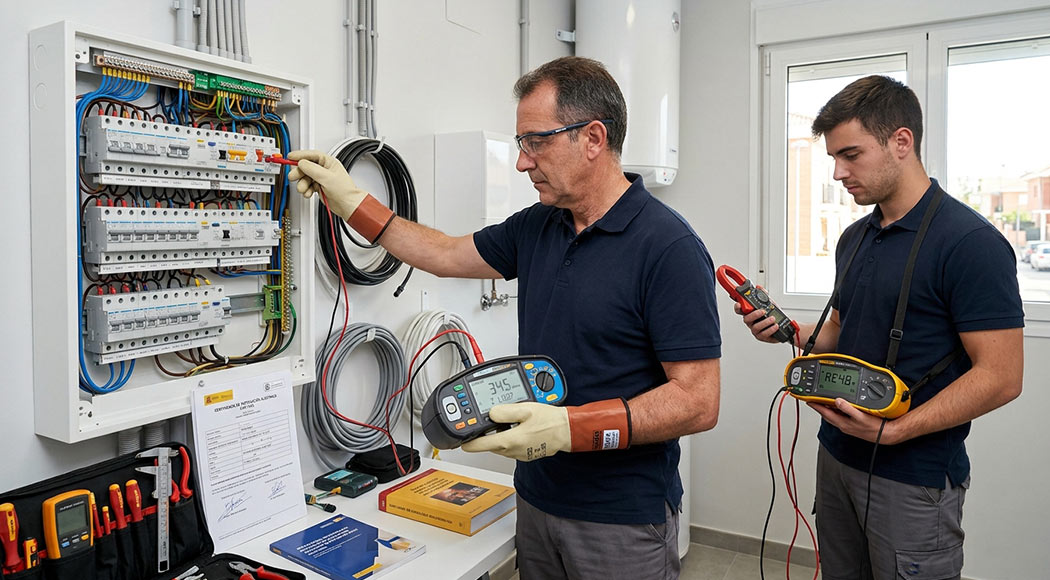
What Are Electrical Measurements?
Electrical measurements are processes used to determine the value of an electrical parameter by means of appropriate measuring instruments.
For example, measuring the voltage of a cable in an electrical system.
Instruments and Equipment for Electrical Measurements
There is a wide range of measuring instruments available, including voltmeters, multimeters, clamp meters, lux meters, earth resistance testers, calipers, and many others.
Are All Measuring Instruments Suitable?
No, not all electrical measuring instruments are suitable for every task. The choice of equipment depends on the type of measurement required and the project for which the measurement results are needed.
For example, when performing electrical certifications, it is essential to use certified measuring instruments that comply with the European Standard UNE-EN 61557. This standard regulates measuring equipment used in electrical installations, particularly devices intended to verify safety parameters such as insulation resistance, earth resistance, and other critical measurements necessary to ensure proper operation and safety.
Electrical Measurements with a Multimeter: The Most Common Instrument
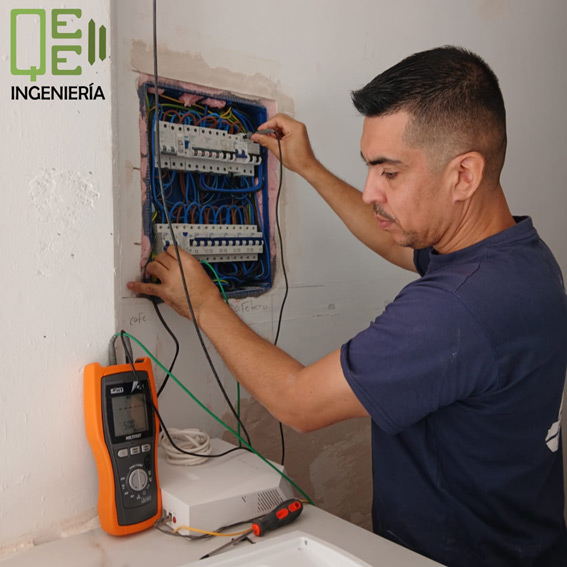
Multimeters are among the most versatile and widely used electrical measuring instruments. A wide variety of models is available on the market, offering different features and price ranges.
If a multimeter is certified according to UNE standards, its price generally exceeds €500, as it meets the requirements for professional measurements and electrical certifications. On the other hand, basic or non-certified multimeters can be purchased for less than €100, although they are not suitable for official measurements or certification purposes.
Below are some of the measurements that can be carried out with a multimeter:
Voltage
| With power? | Yes. If there is a light fixture connected, it should be switched on. |
| How is the measurement performed? | Measure between phase and neutral, or between phase and phase in three-phase systems (never phase and earth). |
| Values |
Symbol: V Single-phase: 230 V (phase to neutral) Three-phase: 400 V (phase to phase) Phase to earth: 230 V Neutral to earth: 0 V |
| What is it used for? | To verify that power is reaching the circuit correctly, identify phase and neutral conductors, and determine whether the installation is single-phase or three-phase. |
Insulation Resistance
| With power? | No power |
| How is the measurement performed? | The tester is connected at both ends of the electrical circuit to verify that continuity exists from the starting point to the endpoint. A positive result produces an audible beep. |
| What is it used for? | To identify cables and detect interruptions, faults, leaks, or poor connections that prevent current flow. |
Continuity Test (Audible Beep)
| With power? | No power. Care must be taken with equipment connected to outlets, as it may be damaged. All devices should be unplugged before testing. It is generally safer to perform the test with the earth conductor connected to reduce the risk of damage. |
| How is the measurement performed? | Measure between conductors that are not connected together:
|
| Values | Megohms (MΩ) Greater than 999 MΩ or above 500 MΩ: Excellent Less than 5 MΩ: Serious issue |
| What is it used for? | To assess the quality of the cable insulation. |
Loop Impedance (Earth Fault Loop Impedance)
| With power? | Yes. |
| How is the measurement performed? | Phase + Earth. It is recommended to carry out the measurement at the furthest socket outlet. |
| Values | Ideally below 20 Ω. |
| What is it used for? | To evaluate the effectiveness of the earthing system. |
Clamp Meter (Ammeter)
The ammeter, commonly known as a clamp meter, is an electrical measuring instrument designed with a clamp-shaped sensor that allows measurements without disconnecting the circuit.
The device measures current under load, meaning while the installation is operating:
Measuring current (A): When the clamp surrounds only the phase conductor, it measures the current flowing through that cable, expressed in amperes (A).
Detecting leakage (mA): When the clamp surrounds both phase and neutral conductors simultaneously, it can detect current leakage, expressed in milliamps (mA).
These leakage currents indicate electricity that is not returning through the neutral conductor and may reveal insulation faults or safety issues.
Lux Meter
A lux meter is used to measure illumination levels and is operated while the installation is energized.
Measurements must be taken at the point where light actually reaches the surface, avoiding shadowed areas that could distort the results.
Results are expressed in lux and indicate the amount of light reaching a surface. This allows verification that lighting levels and fixture distribution meet regulatory requirements or the intended use of the space.
Earth Resistance Tester
An earth resistance tester is used to measure the quality and effectiveness of grounding systems.
Measurements are performed following specific testing procedures, and results help verify that the earthing system complies with safety standards and provides adequate protection against electrical faults.
Caliper
A caliper is a useful instrument for measuring the diameter or cross-sectional area of electrical conductors.
Knowing the actual conductor size is essential because it determines the cable’s current-carrying capacity and directly affects the safety of the electrical installation.
Where to Calibrate Electrical Instruments
To ensure accurate and reliable measurements, electrical instruments such as multimeters, clamp meters, lux meters, and earth resistance testers should be calibrated periodically.
Calibration guarantees compliance with standards and regulations while preventing measurement errors that could affect safety or legal compliance.
In Spain, FEMPA provides professional calibration services for electrical measuring instruments.
Safety Precautions Before Taking Measurements
Before performing any electrical measurement, several safety measures must be followed.
Appropriate Personal Protective Equipment (PPE), including insulated gloves and safety footwear, must always be used.
A visual inspection of the installation should be carried out beforehand to identify any visible damage or abnormalities.
Finally, it is essential to determine whether the measurement is being performed safely according to the state of the circuit.
We Can Help You With Electrical Measurements and Testing in Alicante
When Is It Mandatory to Submit an Electrical Measurement Report?
1. New Electrical Installations
It is mandatory to submit an electrical measurement report or certificate (together with the Electrical Installation Certificate – CIE) when:
A new electrical installation is carried out in homes, commercial premises, or industrial facilities.
The installation is being commissioned before the relevant authority or electricity distribution company.
2. Renovations or Extensions
The report is also required when:
A significant modification is made to the installation (for example, a power upgrade, new circuits, switchboards, or electrical lines).
Extensions are carried out that alter the original safety or design conditions of the installation.
3. Periodic or Regulatory Inspections
An electrical measurement report is required for:
Industrial installations and public-access buildings (hospitals, schools, entertainment venues, petrol stations, etc.) that must undergo periodic inspections in accordance with ITC-BT-05 of the Low Voltage Electrical Regulations (REBT).
During these inspections, measurements are checked to ensure they comply with the required standards and values.
4. Legalising or Registering Electrical Installations
An Authorised Inspection Body (OCA) or the relevant authority may require an electrical measurement report as part of the documentation needed to:
Legalise an installation.
Renew a certificate or inspection report.
Correct deficiencies identified during an inspection.
Conclusion: The Importance of Professional Electrical Measurements
Electrical measurements are essential to ensure safety, efficiency, and regulatory compliance in any electrical installation, whether residential, industrial, or commercial. Skipping this step can lead to serious risks for people, property, and the electrical system itself.
Below are the key advantages of professional electrical measurements:
Safety
Prevention of electrical accidents: Professional testing helps detect short circuits, current leakage, and grounding faults, reducing the risk of electric shock and fire.
Protection of people and equipment: Ensures that protective devices such as circuit breakers and residual current devices (RCDs) operate correctly in the event of overloads or faults.
Regulatory Compliance
Electrical installations must comply with local and international regulations, such as Spain’s REBT (Low Voltage Electrical Regulations).
Professional measurements provide documented proof that the installation meets legal requirements, which is essential for electrical certificates and compliance documentation.
Energy Efficiency
Helps identify excessive energy consumption and power losses.
By measuring parameters such as current, voltage, power factor, and earth resistance, circuits can be optimized to reduce unnecessary electricity costs.
Diagnosis and Preventive Maintenance
Detects defective or ageing components before they fail completely.
Preventive maintenance planning reduces unexpected downtime, emergency replacements, and unforeseen expenses.
Protection of Installations and Equipment
Sensitive equipment such as computers, household appliances, and industrial machinery require appropriate voltage levels and circuit continuity.
Professional measurements ensure there are no voltage spikes, fluctuations, or harmonic distortions that could damage equipment.
Peace of Mind and Quality Assurance
An electrical measurement report certifies that the installation is operating correctly.
This is particularly valuable during renovations, property sales, inspections, or audits, providing confidence to owners, buyers, and clients.
Why Are Electrical Measurements Important?
They help prevent electrical accidents.
They detect electrical faults and hidden issues.
They verify that electrical circuits are functioning correctly.
They ensure the quality and efficiency of electrical systems.
They help reduce electricity costs and save money on energy bills.